A kernel live patch replaces functions in a running kernel while tasks may be in the middle of calling them. Livepatch handles this with a transition: a period during which each task is moved, one at a time, from the old code to the new code when it is safe for that task. A transition has to reach every task, and a task that is exiting can fall outside the places it looks.
RCU (read-copy-update) is a synchronization mechanism in which a writer waits for readers that began earlier. Tasks RCU is a flavor of it, meaning a variant with its own definition of what a reader is, whose grace period waits for every task to pass through a point where it cannot be inside a trampoline. A trampoline is a small piece of generated code that tracing and BPF (a virtual machine inside the kernel) jump through before it is freed. Tasks RCU needs to find every task that might still be running kernel code, which is the same need livepatch has. Its authors solved the exit case with a pair of overlapping windows. A patch series posted to LKML (the Linux Kernel Mailing List) on 2026-11-23 and 2026-11-24 proposes to give livepatch the same protection by reusing the Tasks RCU exit lists.
This post walks through the pieces in order: how a transition scans and switches tasks, what the exit path looks like, how Tasks RCU and Tasks Trace RCU work, and then the series. Code references are to the next branch of the RCU tree on 2026-11-24 (2348d158c7fc).
Terms used in this post
- Task list: the kernel’s list of all processes and threads. Code walks it with
for_each_process_thread()while holdingtasklist_lock, the reader-writer lock that protects it. - Self-reaping task: a task whose exit does not wait for a parent to collect it, so the kernel removes it from the task list by itself, inside
exit_notify(). A task that is not self-reaping is removed when its parent collects it, which can also happen before the task has finisheddo_exit(); the window described below then starts later but ends at the same place. - Transition: the livepatch period during which tasks converge to the new code (when enabling a patch) or back to the old code (when disabling or replacing one).
- Switch (a task): set the task’s
patch_stateto the target state. A context switch is the scheduler replacing the running task on a CPU. This post uses “switch” only for the first and writes “context switch” for the second. - Grace period (Tasks RCU): the wait until every task has done something that proves it is not inside the protected code.
1. What a livepatch transition is
Every task has a field patch_state. It takes one of three values, defined in include/linux/livepatch.h:
| value | name | meaning |
|---|---|---|
| -1 | KLP_TRANSITION_IDLE |
no transition in progress for this task |
| 0 | KLP_TRANSITION_UNPATCHED |
the task uses the old code |
| 1 | KLP_TRANSITION_PATCHED |
the task uses the new code |
Two globals describe the transition itself: klp_transition_patch (the patch being applied) and klp_target_state (where tasks are heading). Because both are single variables, one transition runs at a time. The diagram shows enabling a patch; for disabling, the roles of UNPATCHED and PATCHED swap.
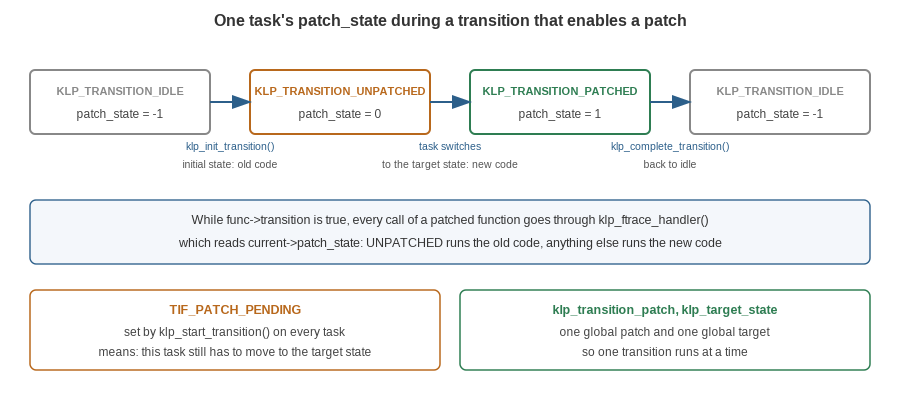
What makes this work is the handler that every patched function goes through. Livepatch hooks each patched function with ftrace, the kernel’s function-entry hook, and while func->transition is true the handler reads the calling task’s patch_state: a task in UNPATCHED runs the old function and any other state runs the new one (kernel/livepatch/patch.c, klp_ftrace_handler()). Moving a task from state 0 to state 1 is therefore the moment that task starts running the new code.
A small example. A patch replaces foo(). Three tasks exist when the patch is enabled: task X sleeping inside foo(), task Y running in user space, task Z a kernel thread that never calls foo(). klp_init_transition() sets all three to UNPATCHED. klp_start_transition() marks all three with TIF_PATCH_PENDING (TIF stands for thread info flag), meaning “this task still has to move to the target state”. Y switches on its next return from the kernel. Z is checked by the scanner and switches, when it is off CPU, because foo() is not on its stack. X cannot switch while foo() is on its stack, so it keeps using the old foo() until it leaves it. The transition completes only after X has also switched.
2. The transition scan
A transition is driven by four functions, and each of them walks the task list under tasklist_lock:
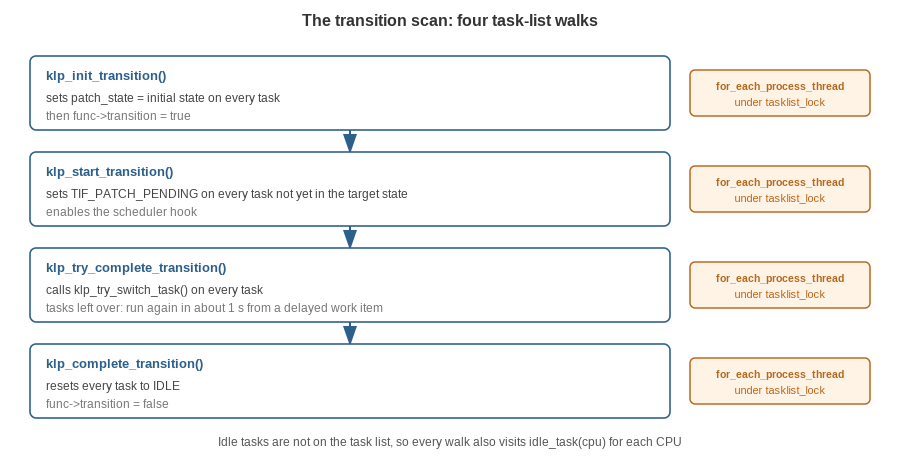
The first walk is representative (klp_init_transition() in kernel/livepatch/transition.c):
read_lock(&tasklist_lock);
for_each_process_thread(g, task) {
	WARN_ON_ONCE(task->patch_state != KLP_TRANSITION_IDLE);
	task->patch_state = initial_state;
}
read_unlock(&tasklist_lock);
The idle tasks, one per CPU, are not on the task list, so each function also loops over idle_task(cpu) separately.
When klp_try_complete_transition() finds a task it cannot switch, it schedules itself again with schedule_delayed_work(&klp_transition_work, round_jiffies_relative(HZ)). A jiffy is one timer tick and HZ is the number of ticks per second, so HZ jiffies is one second. round_jiffies_relative() moves the expiry to a whole-second boundary so that timers on different CPUs fire together, which is why the retry is “about” once a second. Every SIGNALS_TIMEOUT rounds, defined as 15, it also calls klp_send_signals(), which wakes kernel threads and sends a fake signal to user tasks to push them through a kernel exit. Fifteen failed rounds is roughly fifteen seconds, which matches Documentation/livepatch/livepatch.rst: “The fake signal is automatically sent every 15 seconds.”
klp_synchronize_transition() appears in the code that follows, so here is what it does. It is schedule_on_each_cpu() with an empty work function: it returns after a work item has run on every online CPU, which requires every CPU to context switch. Livepatch uses it instead of synchronize_rcu() because patched functions may run where RCU is not watching, for example before user_exit(); the comment above it in the source says “We can not rely on the RCU infrastructure to do the synchronization. Instead hard force the sched synchronization.” klp_complete_transition() already calls it once. When disabling, it calls it after unpatching the functions, so klp_ftrace_handler() has stopped seeing removed functions before func->transition is cleared. When enabling, it calls it after clearing func->transition, so the handler never sees KLP_TRANSITION_IDLE.
3. The switch code
The decision for one task is klp_try_switch_task(). It ends in two small functions. klp_check_and_switch_task() is the core (abridged to the lines that decide):
if (task_curr(task) && task != current)
	return -EBUSY;

ret = klp_check_stack(task, arg);
if (ret)
	return ret;

clear_tsk_thread_flag(task, TIF_PATCH_PENDING);
task->patch_state = klp_target_state;
return 0;
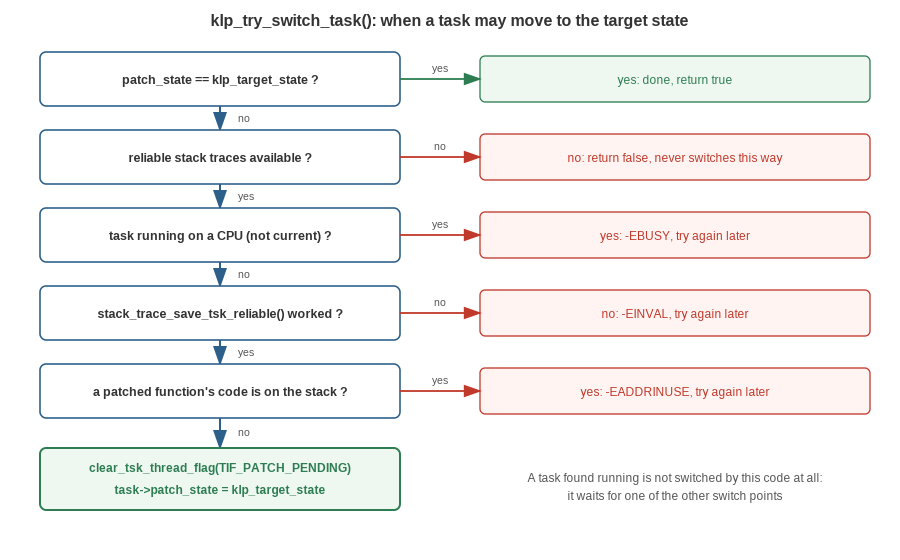
Two details matter for what follows.
The scanner never switches a task that is running on a CPU. task_curr() is true for a task currently on a CPU, and the scanner returns -EBUSY. The switch happens through one of the other switch points below, or on a later scan when the task is off CPU. The call is wrapped in task_call_func() so that the task cannot start running while its stack is being examined.
The stack check uses a reliable stack trace. klp_check_stack() calls stack_trace_save_tsk_reliable(), which either returns every return address on the task’s stack or fails; it never returns a partial answer (Documentation/livepatch/reliable-stacktrace.rst). It saves into a per-CPU buffer of MAX_STACK_ENTRIES, defined as 100, return addresses; the source gives no reason for 100, and a stack of 100 or more entries fills the buffer and makes the trace fail, which the task reports as -EINVAL and does not switch. Then, for each function the patch touches, it asks whether any saved address falls inside that function’s code. If one does, the task is sitting inside a function that is about to change, and the result is -EADDRINUSE.
4. Where a task gets switched
The scanner is one of several ways a task moves to the target state:
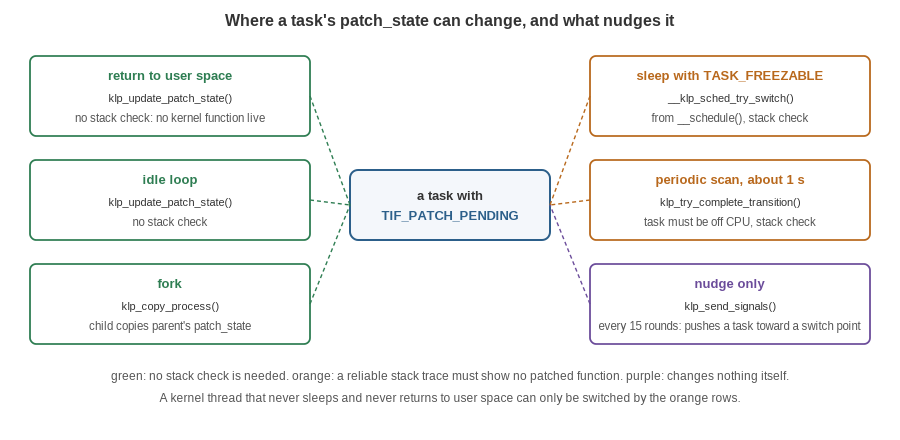
Returning to user space needs no stack check. kernel/entry/common.c calls klp_update_patch_state(current) when _TIF_PATCH_PENDING is set, because a task that has left the kernel has no kernel function live on its stack. The idle loop does the same. A forked child copies its parent’s patch_state in klp_copy_process(), serialized against transitions by tasklist_lock.
The scheduler hook, __klp_sched_try_switch(), comes from commit 676e8cf70cb0, “sched,livepatch: Untangle cond_resched() and live-patching”. It is called from __schedule() through this wrapper (include/linux/livepatch_sched.h):
if (static_branch_unlikely(&klp_sched_try_switch_key) &&
    READ_ONCE(curr->__state) & TASK_FREEZABLE)
	__klp_sched_try_switch();
It fires when the outgoing task is going to sleep with TASK_FREEZABLE set, not when the task is merely preempted, since a preempted task is still runnable. The commit message gives the goal as stopping livepatch from relying on cond_resched() to make forward progress and relying on schedule() with TASK_FREEZABLE set instead: “Just like live-patching, the freezer needs to be able to stop tasks in a safe / known state.” A kernel thread that never sleeps and is only ever preempted is handled by the scanner when it happens to be off CPU, and otherwise has to wait.
5. The exit path, and the tasks a scan cannot see
Now the part that connects livepatch to RCU. It is easiest to start with the incident that exposed it. On 2025-01-21 Yafang Shao reported a panic on production servers running Linux 6.1.52. A livepatch livepatch_61_release6 had been replaced by livepatch_61_release12, and both patched do_exit(). A task faulted at do_exit+1818, an address inside the old module, which had already been unloaded. The instruction at that offset is the one immediately after the call to release_task(). It happened on four servers out of about 50,000, always at that point. The crash site and the unloaded module are in the report; the mechanism below is the explanation the later series adopts. The task had been removed from the task list by release_task(), so the transition could not see it; the transition completed, the old module was freed, and the task returned into it.
This is the order of operations in do_exit() (kernel/exit.c), shortened:
exit_tasks_rcu_start();
exit_notify(tsk, group_dead);
proc_exit_connector(tsk);
...
preempt_disable();
...
exit_rcu();
exit_tasks_rcu_finish();

lockdep_free_task(tsk);
do_task_dead();
exit_notify() takes tasklist_lock for writing. For a self-reaping task it marks the task EXIT_DEAD and calls release_task(), which ends in __unhash_process() and removes the task from the task list with list_del_rcu(). After that point for_each_process_thread() cannot find the task.
But the task is not finished. It still runs the rest of do_exit(), can be preempted and can take interrupts, and stops only at its last __schedule() inside do_task_dead().
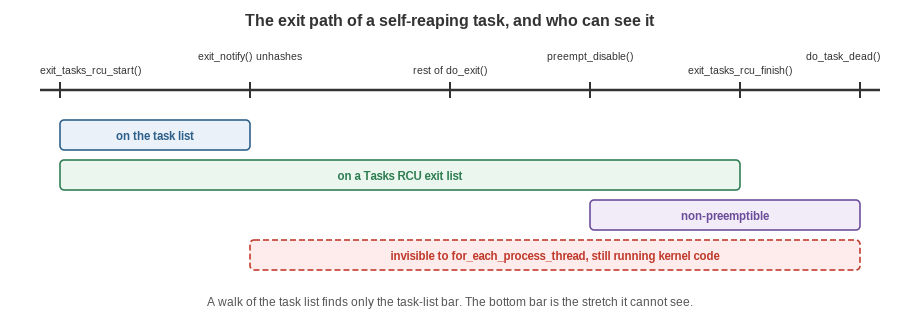
Every livepatch walk in section 2 uses for_each_process_thread(). A task between exit_notify() and do_task_dead(), the stretch labeled “invisible to for_each_process_thread” in the diagram, never gets patch_state = initial_state, never gets TIF_PATCH_PENDING, and is never stack checked. Its patch_state stays at whatever it was, usually KLP_TRANSITION_IDLE. The ftrace handler warns on that state and falls through to the new function, because only UNPATCHED selects the old one. That is a task running new code without having been transitioned.
The worse case is disabling or replacing a patch, as in the crash above. Once the transition is judged complete, the old patch module can be freed, and a task still in that stretch, inside a function from that module or about to return into it, executes freed memory. kernel/livepatch/ at this tree contains no use of exit_tasks_rcu_*, synchronize_rcu_tasks*, or any list of exiting tasks; the only exit-related code there is klp_copy_process() for fork. After the 2025 report, Petr Mladek and Josh Poimboeuf discussed approaches. Josh asked whether livepatch could keep a list of exiting tasks, noted that Tasks RCU already keeps something like it in exit_tasks_rcu_start(), and suggested reusing the same list.
6. How Tasks RCU covers the same path
A Tasks RCU grace period runs in five phases, driven by rcu_tasks_wait_gp() in kernel/rcu/tasks.h:
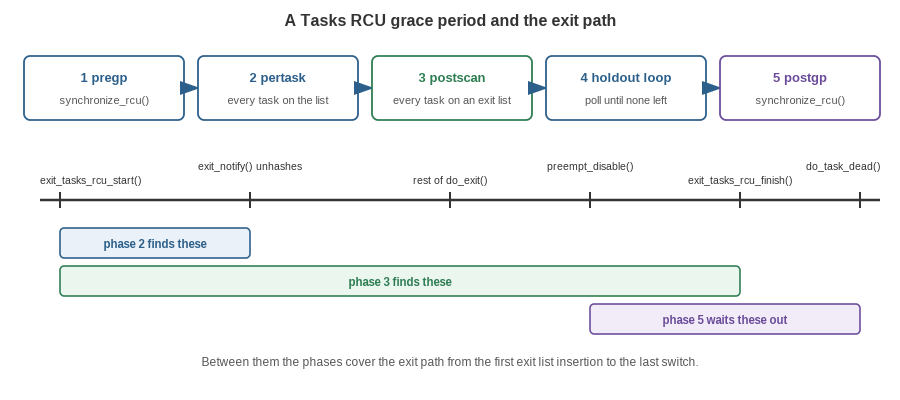
- pregp calls
synchronize_rcu()so earlier scheduler state is visible. - pertask walks every non-idle task and puts the ones that might still be inside the protected code on a holdout list (the tasks the grace period is still waiting for).
- postscan walks the per-CPU exit lists and adds those tasks to the holdout list as well.
- The holdout loop polls the list until it is empty.
- postgp calls
synchronize_rcu()once more.
The exit lists and the last synchronize_rcu() exist for the exit path. The comment in rcu_tasks_postscan() states the design:
/*
 * Exiting tasks may escape the tasklist scan. Those are vulnerable
 * until their final schedule() with TASK_DEAD state. To cope with
 * this, divide the fragile exit path part in two intersecting
 * read side critical sections:
 *
 * 1) A task_struct list addition before calling exit_notify(),
 *    which may remove the task from the tasklist, with the
 *    removal after the final preempt_disable() call in do_exit().
 *
 * 2) An _RCU_ read side starting with the final preempt_disable()
 *    call in do_exit() and ending with the final call to schedule()
 *    with TASK_DEAD state.
 *
 * This handles the part 1). And postgp will handle part 2) with a
 * call to synchronize_rcu().
 */
exit_tasks_rcu_start() puts the task on a per-CPU list before exit_notify() can unhash it. exit_tasks_rcu_finish() removes it after do_exit() has become non-preemptible, with the comment “allowing synchronize_rcu() to wait beyond this point”. The two windows overlap, so no instant of the exit path is uncovered. Window 1 runs from exit_tasks_rcu_start() to exit_tasks_rcu_finish() and is found by postscan. Window 2 runs from the last preempt_disable() to the last schedule. Nothing can preempt the task there, and a region with preemption disabled counts as an RCU read-side critical section: synchronize_rcu() returns only after every such region that was running when it began has ended, which for this tail means after the task’s last context switch.
7. How Tasks Trace RCU works
Tasks Trace RCU is the other Tasks flavor. It avoids this problem by a different design: it never walks the task list. In this tree (include/linux/rcupdate_trace.h) it is a thin layer over SRCU-fast. SRCU is sleepable RCU, whose readers may block, and SRCU-fast is the reader flavor whose lock and unlock are per-CPU counter increments without a memory barrier; the grace period supplies the ordering by calling synchronize_rcu() (or its expedited form). Tasks Trace adds an smp_mb() on top unless CONFIG_TASKS_TRACE_RCU_NO_MB is set, which is the default on architectures that mark their entry code noinstr. A Tasks Trace reader marks itself explicitly:
static inline void rcu_read_lock_trace(void)
{
	int n;
	struct task_struct *t = current;

	rcu_try_lock_acquire(&rcu_tasks_trace_srcu_struct.dep_map);
	n = READ_ONCE(t->trc_reader_nesting);
	WRITE_ONCE(t->trc_reader_nesting, n + 1);
	if (n) {
		// In case we interrupted a Tasks Trace RCU reader.
		return;
	}
	barrier();  // nesting before scp to protect against interrupt handler.
	t->trc_reader_scp = __srcu_read_lock_fast(&rcu_tasks_trace_srcu_struct);
	if (!IS_ENABLED(CONFIG_TASKS_TRACE_RCU_NO_MB))
		smp_mb(); // Placeholder for more selective ordering
}
trc_reader_nesting lets readers nest without extra counter traffic. The first level increments a per-CPU lock counter. Unlocking increments a per-CPU unlock counter, possibly on a different CPU if the task migrated. synchronize_rcu_tasks_trace() is synchronize_srcu() on that structure.
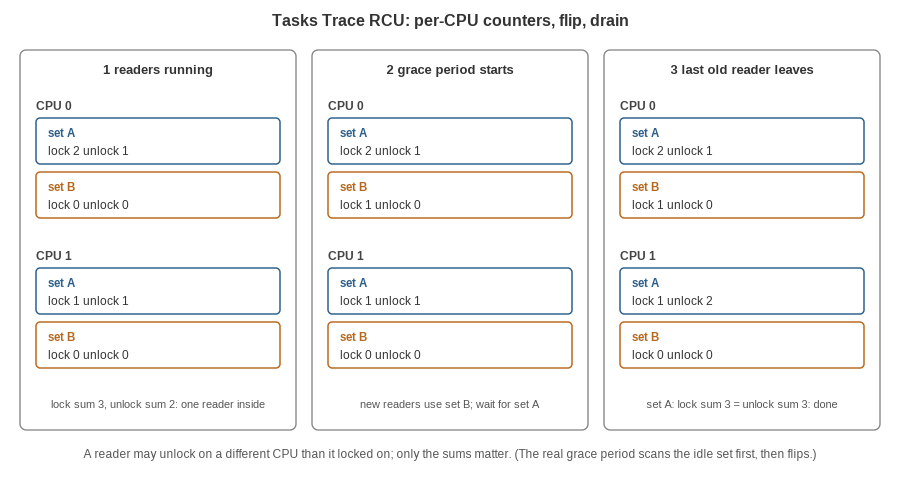
Take two CPUs. In panel 1, set A has CPU 0 at lock 2, unlock 1 and CPU 1 at lock 1, unlock 1. The lock sum is 3 and the unlock sum is 2, so one reader that began before the grace period is still inside. When a grace period starts, new readers use set B. (The real grace period first scans the idle set and then flips; the diagram skips that step.) The grace period waits until set A’s lock sum equals its unlock sum. In panel 3 the old reader finishes and unlocks on CPU 1: set A is now lock 3, unlock 3, and the grace period ends. Only the sums over all CPUs matter, so the reader may unlock somewhere other than where it locked.
Two properties follow from this design. A task inside a reader is counted by the counters whether or not it is on the task list, so exit does not create a blind spot. And a reader may be preempted or may block, which is why BPF programs that can sleep use it. The price is that every protected region must be wrapped in explicit rcu_read_lock_trace() and unlock calls. That is workable for trampolines, which are few and known. Livepatch asks a different question, whether a function that is about to be replaced is on a task’s stack. Any kernel function can be patched, so there is no fixed region to wrap in a reader.
8. The proposed livepatch change
Binoy Ravindran’s series, “livepatch: Do not lose exiting tasks during a transition” (v2, 2026-11-24; v1, 2026-11-23), has three patches and takes up Josh’s 2025 suggestion directly. Its cover letter cites Yafang’s 2025 hybrid-mode RFC as the place the race was discussed.
- rcu-tasks: Add helpers to visit tasks on the exit lists. It adds
rcu_tasks_visit_exiting(), which calls a function on each task on the exit lists under the list locks, andrcu_tasks_snapshot_exiting(), which copies the tasks into a caller-supplied array with a reference held on each, for callers that must sleep. It also moves the cursor thatrcu_tasks_postscan()keeps in a list (a barelist_headon its stack) intostruct rcu_tasks_percpu, asrtp_exit_cursor, so the new helpers can recognize and skip it. - livepatch: Include exiting tasks in the transition. Every step of a transition now also visits the exit lists.
klp_init_transition(),klp_start_transition(),klp_complete_transition()and the reverse and force paths walk them in place undertasklist_lockand skip tasks that are still hashed, so each task is visited once.klp_try_complete_transition()may inspect a stack, so it takes a snapshot with a reference on each task, sized as the count at that moment plus 64 entries of slack for tasks that start exiting before the copy. The 64 is a constant in the patch with no other derivation. Past that, or if the snapshot cannot be allocated, the transition is treated as incomplete and runs again after about a second. The patch also callsklp_synchronize_transition()in two places: inklp_init_transition(), beforefunc->transitionis set, and inklp_try_complete_transition(), beforeklp_complete_transition(). It carriesFixes: d83a7cb375ee(the per-task consistency model). - livepatch: Select TASKS_RCU, suggested by Yafang Shao. The exit lists exist only with
CONFIG_TASKS_RCU. The commit message argues that every kernel that can enable livepatch already builds it: livepatch depends on dynamic ftrace, which selects the need for Tasks RCU,TASKS_RCUdefaults on when preemption is configured, and every architecture that supports livepatch also selectsARCH_HAS_PREEMPT_LAZY, which rules out voluntary preemption, and none selectsARCH_NO_PREEMPT, which no-preemption requires, so preemption is always configured. The patch makes that dependency explicit and changes no configuration today.
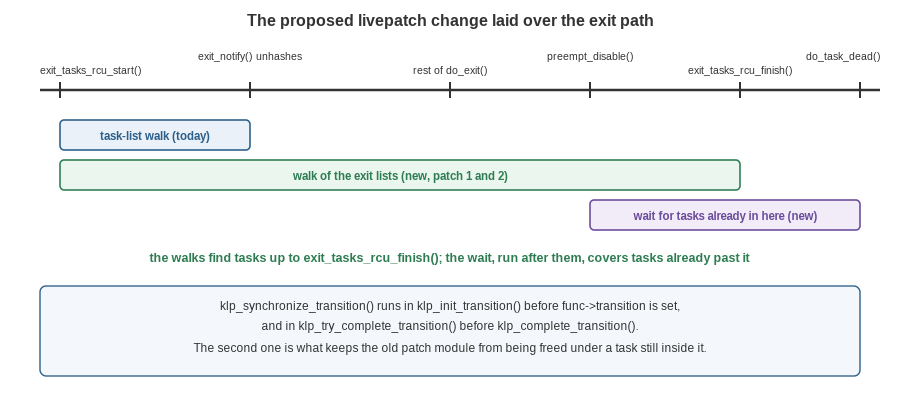
The structure is the same two overlapping parts as in Tasks RCU, with a different tool for the second part. The exit-list walk covers window 1. The wait covers window 2, using klp_synchronize_transition() from section 2: a task in the final non-preemptible stretch cannot be preempted, and the next context switch on its CPU is its last, so any task in that stretch has made its last context switch by the time the call returns.
The walks run before the wait, which closes the gap. The walks of the task list (first, so a task unhashed after that walk was already on an exit list or had passed exit_tasks_rcu_finish()) and of the exit lists run first; the wait runs after them, once in klp_init_transition() and once in klp_try_complete_transition(). A task the walks did not find had already passed exit_tasks_rcu_finish(), so when the wait begins it is in the non-preemptible tail or finished, and the wait returns only after its last context switch. A task that enters the tail after the wait began was visited by the walks: klp_init_transition() gave it a patch_state, and klp_try_complete_transition() completes only once every visited task has switched. Between preempt_disable() and do_task_dead() the sequence in section 5 contains exit_rcu(), exit_tasks_rcu_finish() and lockdep_free_task(), and none of them sleeps: exit_tasks_rcu_finish() takes a raw spinlock with interrupts off, lockdep_free_task() is an empty inline in this tree, and exit_rcu() only calls __rcu_read_unlock() and the deferred quiescent-state check. Without CONFIG_TASKS_RCU the exit lists do not exist and only the tail wait remains, which is why patch 3 selects it. The cost is two extra schedule_on_each_cpu() calls per transition.
Test results quoted in the cover letter (v2, retested on v7.4-rc2). The tests ran on x86-64 in a virtual machine (QEMU with KVM, the Linux hardware-virtualization interface). Two livepatches built with klp-build (the in-tree tool that builds a livepatch module from a source diff) each replace do_exit() and replace each other ten times per run, with a debug-only 2 second sleep after exit_notify() to widen the window. Twelve runs of ten replacements is 120 replace cycles. Without the series, 9 of 12 runs crashed executing freed module memory. With it, all 12 completed their 120 cycles. With lockdep (the kernel’s lock-order checker), CONFIG_PROVE_RCU (which checks RCU usage rules) and CONFIG_DEBUG_ATOMIC_SLEEP (which warns when code sleeps while preemption is disabled) enabled, the series ran 180 replace cycles, 120 of them with the sleep, and produced no reports. That last option matters here because the argument above depends on the tail of do_exit() not sleeping. Without the sleep, the cover letter reports 20,000 replace cycles with the series, in both the default and preempt=full modes (the boot parameter that selects full kernel preemption on a PREEMPT_DYNAMIC kernel), with no fault and transition times unchanged: medians of 7 to 9 ms and 90th percentiles of about 1.5 s. Those timings include the two extra schedule_on_each_cpu() calls.
Review so far. The kernel.org AI patch-review bot (Sashiko) found two issues in v1. First, a task that is on both the task list and an exit list can switch between the two walks of klp_start_transition() and then have TIF_PATCH_PENDING set again, which trips a WARN_ON_ONCE in klp_complete_transition(); v2 walks the exit lists under tasklist_lock and skips tasks that are still hashed, so each task is visited once. Second, a task past exit_tasks_rcu_finish() but not yet dead is on neither walk; v2 added the klp_synchronize_transition() calls for it. Yafang Shao replied that the exit list alone narrows the window without closing it, and asked how the synchronize call closes the rest; she also asked whether a separate list is needed, and Binoy answered that the exit lists already cover the window. Binoy’s answer has four steps:
- Until
exit_tasks_rcu_finish()the task is on the task list, an exit list, or both. After it, possibly neither. do_exit()callspreempt_disable()beforeexit_tasks_rcu_finish(), so from then on the task cannot sleep, be preempted or migrate.klp_synchronize_transition()returns only after a work item has run on every online CPU, so every CPU has context switched, and any task in that gap has made its last context switch.- So call it in
klp_init_transition()and beforeklp_complete_transition().
He also states the limit: the exit lists exist only with CONFIG_TASKS_RCU, and without it only the final non-preemptible stretch is covered, which is the reason for patch 3. Yafang replied that the explanation makes sense and proposed the select TASKS_RCU change that became patch 3.
As of 2026-11-24 the series is not merged, and the thread has no replies from the livepatch or RCU maintainers yet.
Sources
kernel/livepatch/transition.c,kernel/livepatch/core.c,kernel/livepatch/patch.c,include/linux/livepatch.h,include/linux/livepatch_sched.h,Documentation/livepatch/livepatch.rstandreliable-stacktrace.rstkernel/exit.c(do_exit(),exit_notify(),__unhash_process()),kernel/entry/common.ckernel/rcu/tasks.h(rcu_tasks_wait_gp(),rcu_tasks_postscan(),exit_tasks_rcu_start(),exit_tasks_rcu_finish()),include/linux/rcupdate_trace.h- Commit
676e8cf70cb0, “sched,livepatch: Untangle cond_resched() and live-patching” - LKML: the v2 series, Yafang Shao’s 2025 crash report, Yafang Shao’s 2025 hybrid-mode RFC, Josh Poimboeuf’s exit-list suggestion
Corrections are welcome.