I spent some time recently trying to fit a model into a fixed amount of VRAM,
and hit an interesting puzzle. The suggestion was to lower --ubatch-size. But
I only ever had one session talking to the server, and during generation a
single session produces one token at a time. On the face of it, whatever that
knob controlled was already one, and lowering one to something smaller should do
nothing. So why --ubatch-size?
Digging into it, I learned that the u stands for micro, and that the word batch means three different things depending on who is saying it. Once those three came apart, the knob made sense.
Three things called batch
Most of my intuition about the word batch comes from training. There the
activations flowing through the model have shape [B, T, D]. B is the batch
size, the number of independent training samples being processed together. T
is the time dimension, the token positions within a sample. D is the embedding
dimension, the vector each individual token is represented by.
So if I train on four sentences at once, each 128 tokens long, with a model whose
embedding width is 4096, the tensor is [4, 128, 4096]. Sample 0 might be a
paragraph about cooking and sample 3 a snippet of Python. They are unrelated;
they ride along together only because the GPU is happier with one large matmul
than four small ones. Each of the four samples holds 128 positions, and at each
position sits one 4096-dimensional vector.
That is meaning one, and the key property is that B counts independent
things. Row 0 and row 3 have nothing to say to each other.
Meaning two is llama.cpp’s batch, which is a list of token slots handed to one
llama_decode() call. Each slot carries a token, a position, and the sequence
it belongs to. Six slots means six token positions, which might be six positions
from one conversation, or one position each from six conversations, or any
mixture. It is a work order, not a stack of examples.
![Left: a training batch of four rows, each row a separate example, annotated as the batch dimension, shape [4, 128, 4096]. Right: a llama.cpp ubatch of four rows, each row a single token slot tagged with a sequence id and a position, with rows belonging to three different conversations.](/images/ubatch/batch-two-meanings.svg)
The naming collision between those first two is not worth dwelling on, but the picture is, since almost everything below follows from the fact that llama.cpp’s rows are token slots rather than independent examples.
The actual struct in include/llama.h is a little more general than I drew it.
Each slot has an n_seq_id count and a list of sequence ids, not a single one,
because a token can belong to more than one sequence at a time. That is how
prefix sharing works: a common prompt prefix lives in the cache once and several
sequences point at it.
Meaning three is the ubatch, and it is the one this post is really about. The four knobs in this area are worth separating first:
-nplimits how many conversations can be alive at once. This is the one closest to the training meaning of batch.-csets how many token positions the KV cache can hold.-bsets the largest list of token slots you are allowed to hand to a singlellama_decode()call. This is meaning two.-ubsets how many token positions go through the network in one forward pass. This is meaning three.
The last two are the pair worth pinning down, and the header comments in
include/llama.h distinguish them neatly:
uint32_t n_batch;   // logical maximum batch size that can be submitted to llama_decode
uint32_t n_ubatch;  // physical maximum batch size
Logical means at the API boundary. n_batch is a limit on the caller. If I hand
llama_decode() more slots than that, it refuses:
GGML_ASSERT(n_tokens_all <= cparams.n_batch);
Physical means inside the engine. n_ubatch is what llama.cpp does with the
list it was given: it chops it into pieces of at most n_ubatch slots, and each
piece is a ubatch, one trip through the network. So with the defaults of
n_batch = 2048 and n_ubatch = 512, a 5000-token prompt becomes three
llama_decode() calls from the caller’s side (2048, 2048, 904), and each of
those is split again into ubatches of at most 512, which are what the GPU
actually sees. Ten forward passes in total: four, four, then two.
A couple of consequences fall out of that. n_ubatch is clamped to n_batch at
context creation, so a ubatch can never be larger than the batch it came from.
And under causal attention n_batch is itself clamped to n_ctx, since you
cannot submit more positions than the cache can hold:
cparams.n_batch  = cparams.causal_attn ? std::min(cparams.n_ctx, params.n_batch) : params.n_batch;
cparams.n_ubatch = std::min(cparams.n_batch, params.n_ubatch == 0 ? params.n_batch : params.n_ubatch);
Raising -b on its own therefore does not change the shape of the work the GPU
does. It lets the caller submit longer lists, which saves some per-call
overhead, but the tensor shapes in each forward pass come from -ub.
Lowering it is not symmetric, though, because of that clamp. As long as
n_batch stays at or above the -ub you asked for, -ub is what survives and
-b does not touch the forward pass. Push -b below it and the std::min
bites: the effective n_ubatch becomes n_batch, and the reservation shrinks
along with it. So -b 64 -ub 512 does not give you 512-wide passes, it gives
you 64-wide ones.
So the batch is a request and the ubatch is what actually runs. For the rest of this post I use them in exactly that sense: batch means the list submitted at the API boundary, ubatch means the group of token slots that goes through the network together. The training meaning does not come back. Everything interesting below, the mixing of conversations, the masking, the row-wise argument, happens at the ubatch level, because that is the only one of the three that corresponds to a real tensor.
Where the memory actually sits
Two words are about to do a lot of work, so it is worth pinning them down.
The KV cache is the memory of the conversation. Attention works by comparing
the current token’s query against a key for every earlier token, and then mixing
together those earlier tokens’ values. Keys and values, hence KV. A token’s key
and value at a given layer are projections of that layer’s input for that
position, which already carries the influence of everything before it. What
makes caching them sound is causality: attention only looks backwards, so
nothing computed later can change a key or value that has already been written.
Once a position has been through a layer, its entry is final. Recomputing the
whole prefix on every new token would be quadratic work, so llama.cpp stores
them instead. That store is the KV cache, and its size grows with how many
positions you allow (-c) and how many bytes each entry takes.
The graph is the computation itself, written down. Before running anything, llama.cpp builds a ggml compute graph: a list of tensor operations with fixed shapes, wired input to output, describing one forward pass. Nothing has run yet; it is a plan. Because the shapes are fixed at build time, the allocator can walk the graph and work out exactly how much scratch memory is needed, and it can reuse the same buffers for tensors whose lifetimes do not overlap. That is why sizes have to be known up front, and it is also why a graph whose shapes do not change can be built once and reused.
Worth being precise about what the graph holds, because it is not everything it refers to. The weight tensors appear in it, as leaves feeding the matmuls, but they were already allocated when the model was loaded, into their own backend buffer or straight out of an mmap region. The graph allocator checks for that and skips them:
static bool ggml_gallocr_is_allocated(ggml_gallocr_t galloc, struct ggml_tensor * t) {
    return t->data != NULL // tensor data already set externally
        || t->buffer       // tensor on external buffer (but not yet allocated)
        || ggml_gallocr_is_own(galloc, t);
}
So the graph reads the weights, it does not store them. The only thing it needs memory for is the intermediates, the tensors produced as the pass runs. One copy of each weight serves every forward pass and every ubatch, which is the whole basis of the amortisation argument later on.
With that, VRAM during inference splits roughly three ways: the weights, the KV cache, and a workspace for the graph’s intermediate tensors. Each knob moves a different piece.
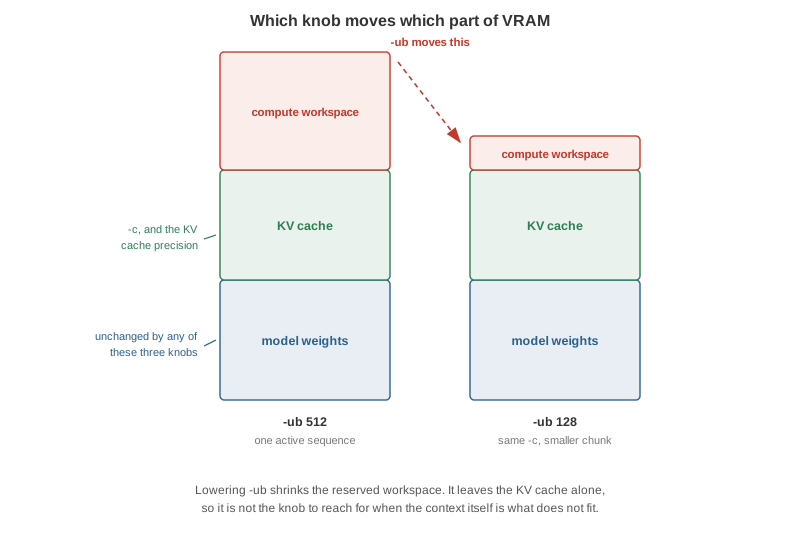
-c and the KV cache precision set the middle slab. -ub sets the top one. The
weights do not care about either.
The reason -ub matters even with a single session is that llama.cpp sizes the
workspace once, up front, for the largest forward pass it might ever be asked to
run. In llama_context::sched_reserve():
const uint32_t n_seqs   = cparams.n_seq_max;
const uint32_t n_tokens = std::min(cparams.n_ctx, cparams.n_ubatch);
It reserves against the prompt-processing graph, then the token-generation
graph, then the prompt-processing graph again, so that nothing has to be
reallocated later when switching between the two. That worst case is driven by
n_ubatch, which follows from the split: the largest tensor the graph ever holds
is one ubatch wide, no matter how long a list the caller submitted.
n_batch is not entirely free, but what it sizes is the output side rather than
the compute workspace. In output_reserve() the output_ids map is n_batch
entries, and the optional per-layer embedding buffers scale with it. Those are
small next to a prefill activation workspace, and they are zero-sized unless you
asked for embeddings.
So the memory is not a dormant prompt graph sitting there doing nothing. It is
one workspace, sized for the biggest thing that might run in it. During
single-stream decode most of it is idle, and lowering -ub is how you tell
llama.cpp not to reserve that much in the first place.
Prefill and decode are not the same shape
The other half of the puzzle is that the two phases of inference have completely different amounts of parallelism available.
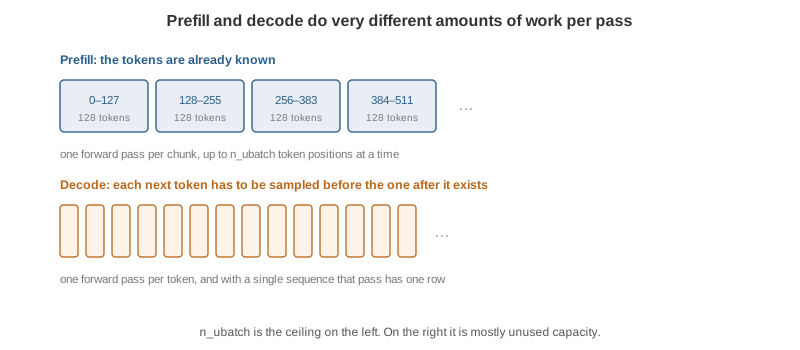
During prefill the prompt tokens are already known, so many positions can go
into one ubatch. During generation each token has to be sampled before the next
one exists, so a single non-speculative sequence contributes one row per ubatch.
-ub is a ceiling that prefill actually reaches and that single-stream decode
almost never does. That is the answer to the question I started with: the knob was
never about how many conversations you have, so having only one does not make it
irrelevant.
That framing holds for a single non-speculative sequence, which contributes only
one new token per step, so lowering -ub has nothing to cut. Two things break
the assumption.
The first is continuous batching itself. Every active slot contributes its own row to the same decode step, so eight live conversations make a decode ubatch eight rows wide.
The second is speculative decoding, where a single slot can contribute several
rows on its own. A small draft model proposes the next few tokens, and the big
model checks them all in one pass instead of one at a time. In
server-context.cpp the slot adds its sampled token and then each drafted token
to the same batch:
add_ok &= batch.add(id, sampled, pos0++, true, false);
for (auto token : spec_draft) {
    add_ok &= batch.add(this->id, token, pos0++, true, false);
}
Either way, decode gets a row count worth the name, and a -ub set below it
splits what would have been one pass into several. Verifying a five-token draft
under -ub 4 costs two passes rather than one, which is exactly the throughput
the technique was meant to buy back.
Worth noting a ubatch is not padded up to n_ubatch. The graph is built for
the actual token count, so a one-token decode really is a one-row matmul rather
than one real row and 127 zeros.
There is padding in the picture, but it is on the other axis. Attention reads
the whole prefix, so besides the rows going in, every graph has a second
dimension: n_kv, how many cached positions the attention step will look at.
That number naturally grows by one per generated token, and if the graph shapes
tracked it exactly, every single decode step would produce a differently shaped
graph that had to be rebuilt and reallocated from scratch.
So llama.cpp rounds it up. llama_kv_cache::get_n_kv() reports not the true
number of occupied cells but that number padded up to the next multiple of a
fixed quantum:
// pad the n_kv value so that the graph remains constant across batches and can be reused
const uint32_t n_pad_cur = std::max(n_pad, 256u);
...
result = std::max(std::min(cells.size(), std::max(n_pad_cur, GGML_PAD(cells.used_max_p1(), n_pad_cur))), result);
With a quantum of 256, a cache holding 700 live positions is reported as 768, and it keeps being reported as 768 until position 769 arrives. So 256 consecutive decode steps all build the identical graph, and only every 256th step pays for a rebuild. The cost is that attention does a little arithmetic over cells that are not really occupied, which the mask discards anyway.
As for where 256 itself comes from: it is a floor hardcoded in that line. The
model-specific n_pad passed in when the cache is constructed is 1 for the
paths I looked at in llama-model.cpp, so the std::max picks 256 and the model
value never matters. It is a tuning constant, not a property of any model, and
the comment above it gives two reasons: graph reuse, and that some backends
simply run faster on that alignment.
Note this is padding of a reported count, not extra allocation. The KV cache
itself was already allocated at its full -c size when the context was created.
Part 1: putting different conversations in the same ubatch
Here is the part I found most interesting. When several conversations are active, llama.cpp does not process them one after another, and it does not run separate forward passes for each. It puts their tokens in the same ubatch.
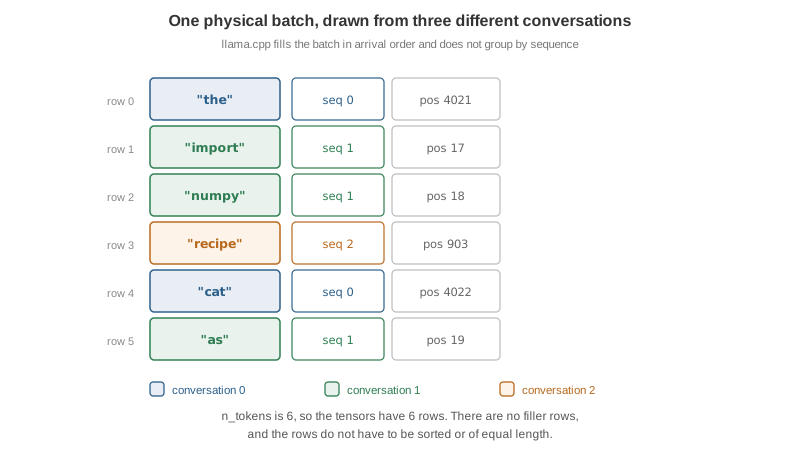
This is what continuous batching produces. The batching decision itself happens above this layer, in the server’s scheduler: it tracks which requests are alive, and each iteration it gathers a token from every slot that needs one into a single logical batch, so requests join and leave the running work as they arrive and finish rather than waiting for a group to be assembled and drained.
split_simple() is what happens next, once that batch reaches llama_decode().
It fills a ubatch by taking token slots in submission order up to n_ubatch,
and does not look at sequence ids at all while doing it. So the scheduler
decides which conversations travel together; split_simple() just carves the
result into executable pieces. The mixing in the diagram above is the
scheduler’s doing, and the reason it is safe is the same either way.
That is for the default unified KV cache. There is a second path, used when the
cache is split per sequence, where split_equal() builds ubatches from
equal-length chunks with ordered sequence ids. So “one ubatch mixes freely” is
true for the common case but not unconditionally true, which is the kind of
detail worth checking in the source rather than assuming.
The picture above raises an obvious question. Row 0 and row 3 are strangers. They are about to be multiplied by the same weight matrices in the same kernel. What stops one from leaking into the other?
The mask is doing the work
Attention is the one place in the layer where rows read other rows, and the mask is what decides which reads are allowed.
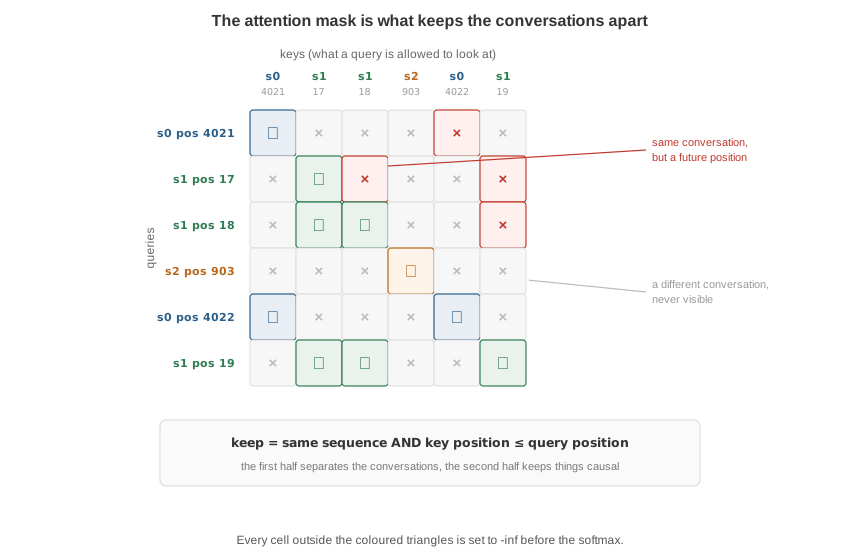
The rule has two halves. A query can see a key only if they belong to the same sequence, and only if the key is not in the future. The first half separates the conversations, the second half is ordinary causal masking. Everything else becomes negative infinity before the softmax, which means those keys contribute nothing at all to the result.
The real thing in set_input_kq_mask_impl has more conditions than my two:
if (cells.is_empty(j))            continue;   // unused cache slot
if (!cells.seq_has(j, seq_id))    continue;   // different sequence
if (causal && cells.pos_get(j) > p1) continue;   // future position
if (swa && is_masked_swa(...))    continue;   // outside the sliding window
There is an empty-slot check, a causal_attn flag that can turn causality off
entirely for models that want bidirectional attention, and sliding-window
masking for the models that use it. The two conditions I care about are in
there, alongside a few others.
One detail I liked: the sequence id used for masking is
ubatch->seq_id[i][0], the first entry in the list. So the multi-sequence
membership I mentioned earlier is asymmetric, a cached cell can belong to
several sequences and be visible to all of them, but a query masks against one.
Chunked prefill is the same mechanism
Once the mask is in view, chunking a long prompt stops looking like a separate feature. The chunks are strictly ordered, chunk two cannot run before chunk one, because chunk two’s queries need chunk one’s keys. But within a chunk the positions go through together, and the mask sorts out their internal ordering.
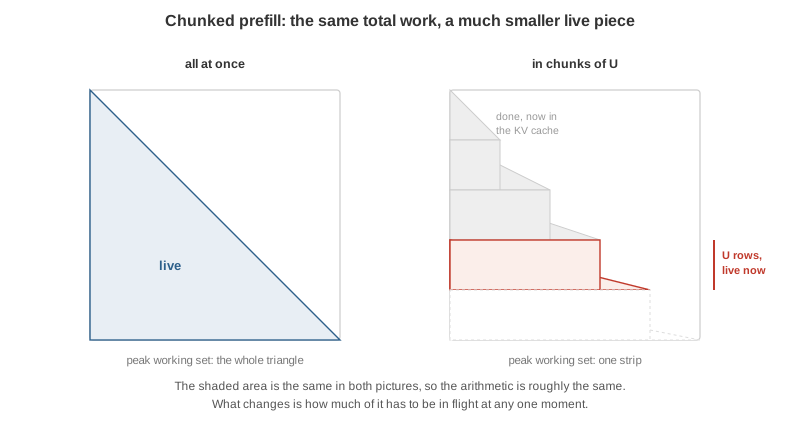
A chunk of U new tokens against C already cached produces a [U, C+U] score
matrix rather than [C, C]. The area under the triangle is about the same
either way, so the total arithmetic does not change much. What changes is how
much of it is in flight at once, which is exactly the workspace the reservation
was sized for.
This is also why a smaller -ub cannot rescue you from a KV cache problem.
Later chunks still read the whole accumulated history. You have made the live
piece smaller, not the history.
Part 2: why the weights do not care which conversation a row came from
The other half of the story is the feed-forward block, and it turns out to be the simpler half once you stop thinking about it as a transformer thing.
In an ordinary neural network, the weights of a layer do not depend on which sample a row came from. Ten samples means ten rows in and ten rows out, and the same weight matrix multiplies all of them. Row three’s output is built from row three’s input and nothing else.
The feed-forward block is exactly that, with tokens in the role of samples.
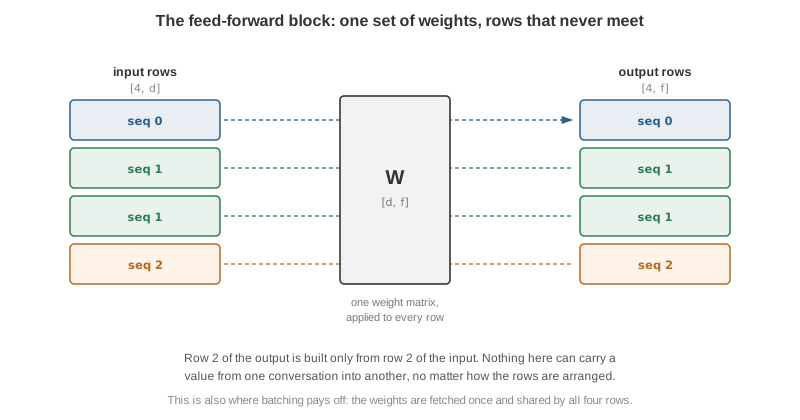
[T, d] @ [d, f] gives [T, f], and output row i depends only on input row
i. It makes no difference whether the rows are consecutive positions from one
prompt or unrelated tokens from four different users. The weights are the same,
and the rows do not interact.
This is also where continuous batching earns its keep. Single-stream decode is mostly waiting on memory: you read an entire weight matrix to process one row. With a full ubatch you read the same weights once and amortise them across every row in it. That is the throughput story, and it is a direct consequence of the sharing.
The output projection, the case worth thinking through
The case that most deserves a careful look is multi-head attention’s output
projection. Each head produces its own output, they get concatenated, and W_O
mixes them. Mixing is the point of that layer. So what stops it from mixing
across tokens too?
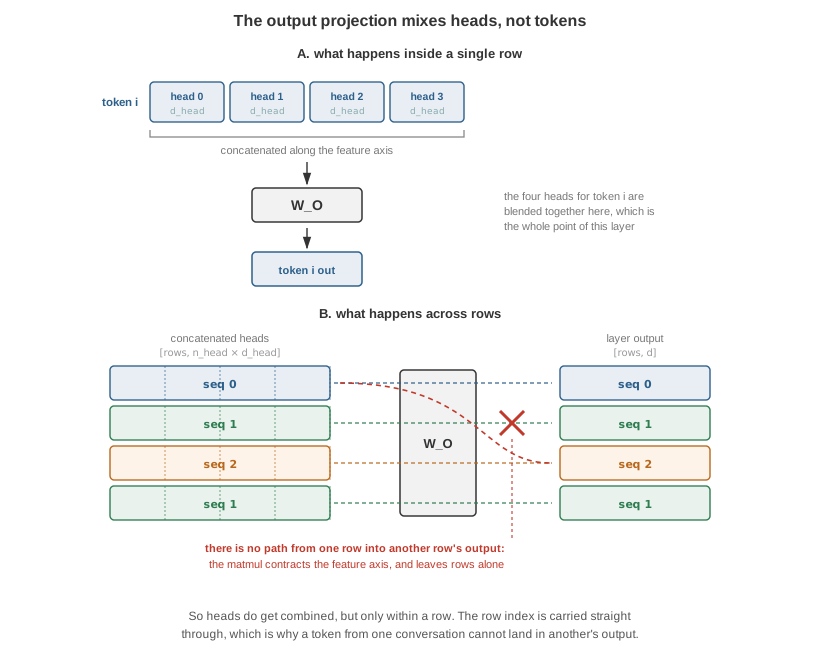
The answer is that the concatenation happens along the feature axis, not the
row axis. For a single token, its head outputs sit side by side in one row, and
W_O contracts along that direction. Head 3’s contribution to token i gets
blended with head 7’s contribution to token i. There is no arrangement of
numbers in W_O that would let it reach a different row, because the matmul
sums over features and carries the row index straight through.
So W_O is a row-wise operation in exactly the same sense the feed-forward
block is. It is a bigger, more interesting row-wise operation, but structurally
it is the same kind of thing.
And the rows going into it are already clean. Each head’s output for token i
is a weighted sum of value vectors, with the weights coming from the masked
softmax. Anything from another conversation had weight zero. So it is clean rows
in, a row-wise operation, clean rows out.
Walking the layer
Having convinced myself about W_O, I went through a whole layer to see whether
anything else crosses rows.
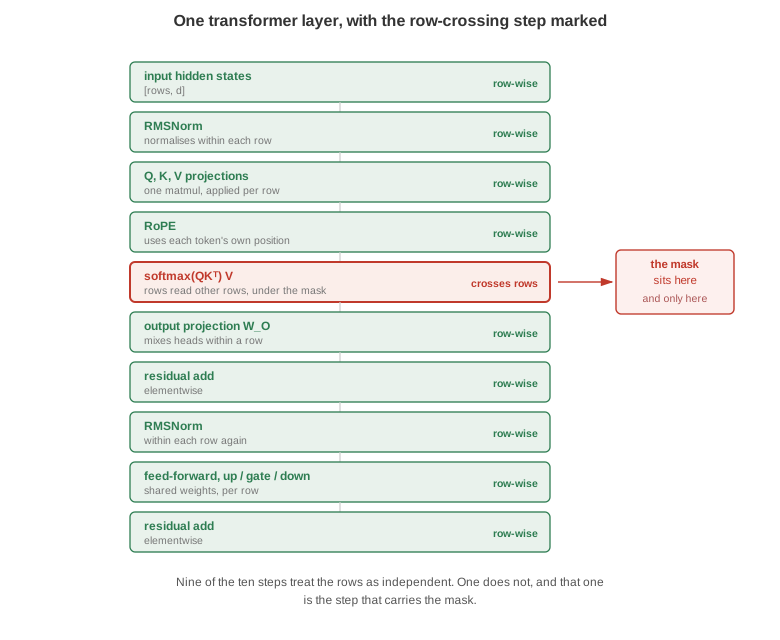
RMSNorm normalises within a row, over that token’s own features. The Q, K and V
projections are one matmul applied per row. RoPE uses each token’s own position,
which is worth pausing on for a mixed ubatch: inp_pos is a tensor of length
n_tokens copied straight from ubatch->pos, so a row at position 4021 and a
row at position 17 sitting next to each other each get their own rotation. The
residual adds are elementwise. The feed-forward block is the shared-weights case
above.
That leaves one step that reads across rows, and it is the one wearing the mask.
This is a satisfying place to land, because it turns “is continuous batching safe” from a question about the whole architecture into a question about one operation. It also explains why the jumbled ordering in the ubatch diagram costs nothing. Nothing in the layer cares what order the rows are in, because nine of the ten steps never look at their neighbours and the tenth consults the mask rather than the layout.
Back to the VRAM question
With the vocabulary sorted out, the practical part is short:
- Lowering
-ubshrinks the reserved workspace, and that is real, even at-np 1. The reservation is worst-case and driven bymin(n_ctx, n_ubatch). - It does not touch the KV cache. That is
-c, the KV precision, and how many contexts you provision. - Lowering
-bdoes not shrink the workspace, as long as it stays at or above-ub. Below that the clamp takes over, the effectiven_ubatchbecomesn_batch, and the reservation follows it down. - It costs prefill throughput and time to first token. For a single
non-speculative sequence it leaves steady-state decode alone, since that
sequence contributes only one new token per step. With multiple active slots
or speculative decoding, decode carries several rows, and a small enough
-ubsplits that into extra passes and costs decode throughput and latency too. - Queueing requests instead of provisioning slots for them is a reasonable
trade. If you know you will never serve four users at once,
-np 1 -c 8192
-ub 64
gives one request the full context and processes prompts in small pieces.
The current defaults, from common/common.h, are n_batch = 2048,
n_ubatch = 512, n_parallel = 1.
I have not done a careful sweep on my own hardware yet. When I do, the two
numbers I plan to watch are the compute buffer size line in the startup log
and prompt-processing tokens per second, across -ub values of 512, 256, 128
and 64. I would expect the buffer to shrink steadily and the prefill speed to
fall off somewhere below the point where the GPU stays busy, but I would rather
measure it than guess where that is.
What I took away
The thing I keep coming back to is that the row dimension of a ubatch behaves like a batch dimension in the ordinary sense, for every operation except one. Attention is the exception, and attention has a mask.
Those two halves do different jobs, and it is worth not blurring them. Weight sharing comes from the row-wise structure alone. A matmul applies the same weight matrix to every row and carries the row index straight through, so one copy of the weights serves every token in the ubatch. That holds whether the rows come from one conversation or six, and the mask has nothing to do with it. It is the same reason weights are shared across a training batch: it is just what a matmul does.
The mask does the other job. It is what allows the rows to be strangers. Attention is the only step that reads across rows, so it is the only place where mixing conversations could go wrong, and the mask is what stops it.
Continuous batching needs both. Weight sharing is what makes it worth doing, since the weights get read once and amortised across the whole ubatch. The mask is what makes it correct.
The naming is unfortunate too. -b and -ub read like a knob and its
fine-tuning companion, but they act on different things. -ub sets how many
token slots go through the network at once, which is what fixes the shape of
every intermediate tensor and therefore the size of the workspace reservation.
-b sets how many slots the caller may pass to llama_decode() in one go,
which changes how often that call is made and sizes output_ids and the
optional embedding buffers, but not the tensors inside the pass. So when a VRAM
problem sends you looking for a batch size to lower, the one spelled -ub is
the one that moves the workspace.
Two things I want to measure next: how much of the workspace reservation is
genuinely unavoidable versus conservative, and where the remaining prefill time
goes at small -ub. The terminology, at least, is now settled.
Source references in this post are against llama.cpp master as of August 2026,
mainly include/llama.h, src/llama-context.cpp, src/llama-kv-cache.cpp,
src/llama-graph.cpp, ggml/src/ggml-alloc.c and
tools/server/server-context.cpp. If something here is wrong I would like to
know.